
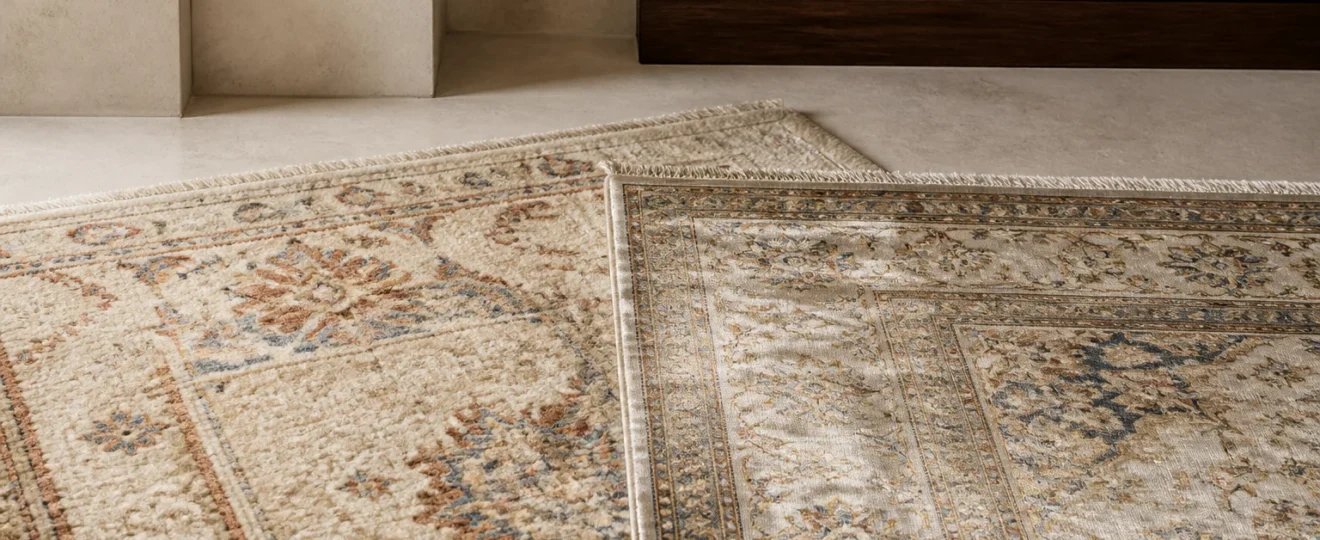
Choose a wool rug for resilience, warmth and everyday use; choose a silk or silk-rich rug when fine detail, lustre and a lower-traffic setting matter more. Neither fibre is universally better. The right decision depends on the room, the way the rug will be used and how much specialist care you are prepared to give it.
Wool vs silk rugs at a glance
| Consideration | Wool rug | Silk or silk-rich rug |
|---|---|---|
| Best suited to | Living rooms, bedrooms and many regularly used spaces | Formal rooms, low-traffic areas and display-led interiors |
| Appearance | Soft, substantial and usually more matte | Lustrous, finely detailed and responsive to changing light |
| Resilience | Elastic fibres help the pile recover from ordinary compression | Less elastic and more vulnerable to abrasion, crushing and light |
| Care | Regular gentle vacuuming and periodic specialist cleaning | Very low suction, careful light control and fibre-specific professional cleaning |
| Budget | Available across a wide range of qualities and prices | Fine hand-knotted examples are usually more costly |
Why wool works so well in rugs
Wool has natural crimp and elasticity. That structure gives a well-made wool pile body and helps it recover from moderate pressure. It also holds dye beautifully, feels comfortable underfoot and can be spun in ways that produce everything from a softly rustic surface to a crisp, finely knotted finish.
Wool is not indestructible. Grit can work down into the pile and abrade fibres, moisture can weaken the fibre while it is wet, and clothes moth or carpet beetle larvae may feed on wool. Even so, good wool is generally the most practical natural pile fibre for a rug that will be lived with every day.
What makes silk rugs distinctive?
Silk is a fine continuous filament. In a rug, that fineness can support very closely worked drawing and a smooth surface that reflects light. The same design may appear lighter from one direction and deeper from another, which gives silk rugs their characteristic visual movement.
Silk is strong for its diameter, but strength alone does not make it ideal for heavy floor use. It is less elastic than wool, can show crushing and abrasion, becomes weaker when wet and is particularly sensitive to prolonged light exposure. A fine silk rug therefore rewards careful placement and a conservative cleaning approach.
What about wool-and-silk rugs?
Many contemporary and traditional rugs combine a wool ground with silk highlights. The wool supplies body while silk catches the light in selected motifs or borders. This can be an excellent compromise, but the whole rug should still be cared for according to its most sensitive component. A cleaner must identify both fibres and test dyes before treatment.
Choose by room, not by fibre alone
Living room
For a principal seating area, wool is usually the calmer choice. It tolerates regular use better and works with an underlay to create a comfortable, stable surface. A wool-and-silk rug may also work where shoes are removed and furniture does not move across the pile.
Bedroom
Both fibres can be suitable. A silk or silk-rich rug can work beautifully beside or partly beneath a bed because foot traffic is lighter, while wool offers warmth and easier maintenance.
Dining room
Wool is generally more forgiving. Dining chairs repeatedly cross the surface and spills are more likely. Choose a size that keeps the rear chair legs on the rug when the chair is in use, and lift rather than drag furniture.
Hallway or entrance
Silk is rarely the practical choice. Look for a dense, well-constructed wool rug and use a compatible underlay. Outdoor soil should be trapped before it reaches the rug.
How can you tell whether a rug is real silk?
Do not rely on shine alone. Viscose and other manufactured fibres can also appear glossy, while some genuine silk rugs have a restrained sheen. Labels, provenance, close examination of the pile and foundation, and the behaviour of the fibre under magnification are more useful than improvised burn tests, which can damage the rug and still be misleading.
If fibre identification affects a purchase or treatment decision, ask an experienced rug specialist or textile conservator to examine the piece.
Care differences that matter
- Vacuuming: use low suction and no rotating brush on both; use even greater caution with silk and unstable pile.
- Light: protect all rugs from strong direct sunlight, with particular care for silk.
- Spills: blot immediately with clean absorbent material. Do not scrub or apply household stain remover.
- Cleaning: choose a specialist who will identify fibres, test dyes and adapt the method to the rug’s construction and condition.
- Rotation: turn the rug periodically where practical to balance traffic and light exposure.
For placement advice, read our living-room rug size guide. You can also browse the collection or ask our London team to compare fibres in person.
Frequently asked questions
Is a silk rug suitable for a living room?
It can be, especially in a formal or lightly used room. For a busy family seating area, wool is normally more forgiving.
Are silk rugs harder to clean?
They require more cautious handling because moisture, abrasion, dye movement and pile distortion can cause permanent change. Specialist cleaning is recommended.
Do wool rugs shed?
Some loose fibre is normal, particularly with a newer cut-pile rug. Persistent heavy shedding, exposed foundation or rapid pile loss deserves an assessment.
Further reading
The Canadian Conservation Institute’s textile guidance explains the different physical properties and vulnerabilities of wool and silk.